


Black soap bars look like they mean business. Pick one up and the pitch writes itself: charcoal pulls out oil, impurities and odor, so it must be the strongest option for sweaty underarms and oily skin. The reality is more modest, and more interesting. Activated charcoal does have a real, well-understood property. It just doesn’t do everything the packaging implies.
This guide separates what activated charcoal genuinely does on skin from what hasn’t been shown, so you can decide whether a charcoal bar belongs in your shower.
What “Activated” Charcoal Actually Is
Activated charcoal is carbon made from materials like wood, coconut shell or peat, then heated at high temperature, usually with steam. That treatment riddles the carbon with microscopic pores. The result is a very fine black powder with an enormous internal surface area; depending on the material and process, figures of several hundred up to roughly 3,000 square meters per gram are reported in the literature.
That surface area is the whole story. Activated charcoal has been used for centuries in medicine as an emergency treatment for certain poisonings, and in industry to filter water and air, precisely because so much surface is available for other molecules to stick to.
Adsorption, Not Absorption
The word matters. Absorption is a sponge soaking up water. Adsorption is molecules attaching to the surface of a solid through weak intermolecular forces. Activated charcoal works by adsorption: certain molecules, particularly many gases and oily, carbon-based compounds, tend to cling to those pore surfaces.
That’s why charcoal shows up in odor-control products. Many odor molecules are small volatile compounds, and volatile compounds adsorb readily onto activated carbon. It’s a legitimate property, not marketing invention.
Where the Claims Run Ahead of the Evidence
Here’s the caution that most charcoal soap pages skip. Showing that charcoal adsorbs something in a lab or an air filter is not the same as showing a rinse-off bar changes how you smell or how your pores behave.
- Contact time is short. A soap sits on your skin for perhaps a minute before it’s rinsed down the drain, taking the charcoal and whatever stuck to it along with it. Adsorption also has a ceiling: once the binding sites on the charcoal are occupied, no more can attach.
- It works at the surface. Charcoal particles sit on the skin, not inside follicles, so “deep cleaning pores” and “detoxing” overstate what a surface wash can do. “Detox” is a marketing word; skin doesn’t store toxins that a soap bar removes.
- Clinical evidence is thin. A review of cosmetic uses of activated charcoal concluded there is little to no clinical evidence behind many of the claims made for it, and a dermatology review titled “Charcoal: An ancient material with a new face” in Clinics in Dermatology found no evidence supporting exfoliating or anti-aging benefits, while noting charcoal is generally safe topically. We found no controlled trial testing charcoal soap specifically for body odor.
The fair summary: charcoal can contribute some surface oil and odor adsorption during washing, but it’s a supporting ingredient. The soap base, which actually loosens oil and sweat residue and removes bacteria, does most of the cleaning.
Why Underarm Odor Needs More Than a Black Bar
Underarm odor isn’t caused by sweat itself. Fresh sweat is largely odorless; the smell develops when bacteria on the skin break down proteins and lipids in apocrine sweat into volatile, sulfur-containing compounds. Because skin bacteria repopulate within hours of washing, any cleanser, charcoal or not, works at the moment you wash and has limited power over what happens later in the day.
That’s the realistic frame for a charcoal bar: it can help you start clean, with less surface oil and residue for bacteria to work with, but it isn’t a substitute for the other habits that matter, like drying thoroughly, wearing breathable fabrics and washing the whole area rather than just the underarm itself.
Where Persimmon Comes In
Persimmon is a different kind of ingredient. It’s rich in tannins, plant polyphenols with astringent properties, and persimmon tannin (kakishibu) has a long history in Japan as a traditional deodorizing and preserving agent. Pairing a tannin-rich plant extract with activated charcoal is a sensible formulation idea: charcoal contributes surface adsorption, persimmon contributes a traditionally used odor-control botanical. To be straightforward, the evidence for persimmon in a rinse-off soap is also more traditional and mechanistic than clinical, so we describe it as supportive rather than proven.
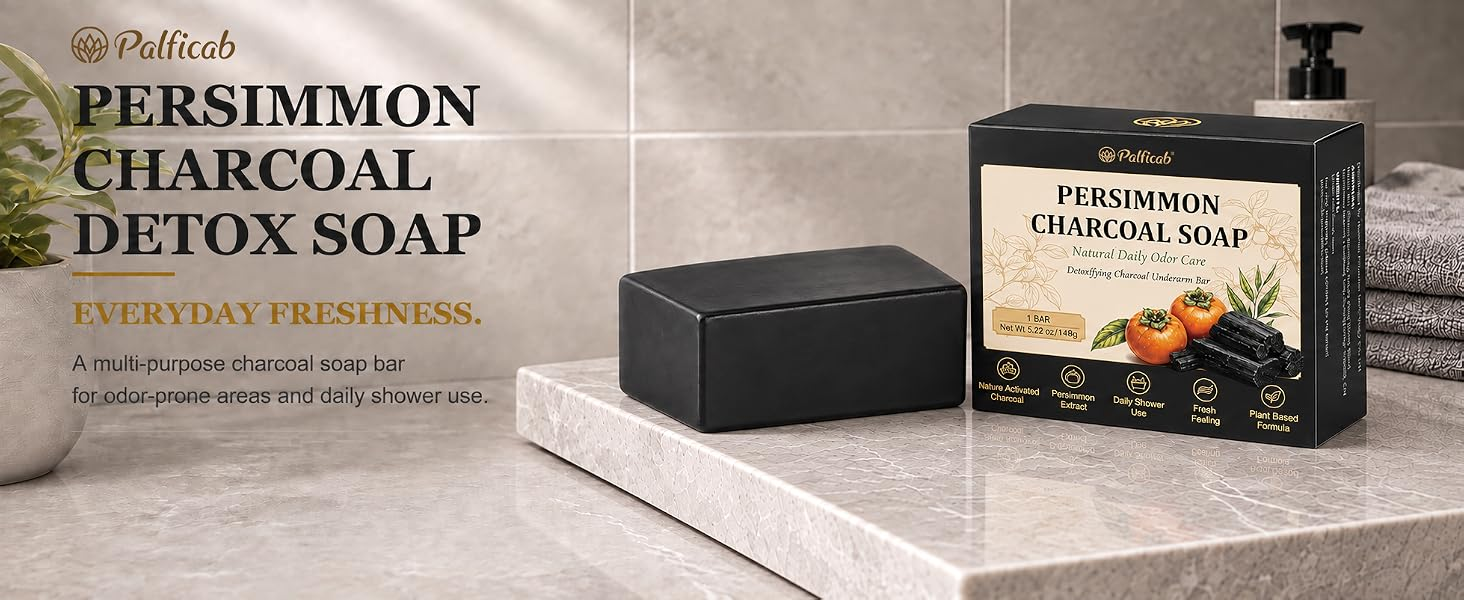
Our take: The PALFICAB Charcoal Soap with Persimmon for Underarms, Face & Body (5.22 oz) combines activated charcoal (listed as Charcoal Powder), persimmon extract and persimmon essential oil in a bar made for oily and blemish-prone skin and for underarm odor control. It comes with a foaming net to build a rich lather. We position it as a thorough, everyday cleansing bar, not as a medical treatment.
View the Charcoal Persimmon Soap
Who Is Most Likely to Like a Charcoal Bar
Oily or combination skin. Charcoal’s affinity for oil and the strong cleansing of a soap base suit skin that gets shiny by midday.
People who like a deep-clean feeling in the shower. Much of the appeal is sensory, and that’s a perfectly valid reason to enjoy a product, as long as expectations stay realistic.
Body use first. Back, chest and underarms generally tolerate a charcoal bar better than the face does.
Who Should Be More Careful
Dry, sensitive or eczema-prone skin. A strongly cleansing bar can leave dry skin feeling tight, and one dermatologist commentary notes charcoal on its own can be mildly abrasive.
Freshly shaved or irritated underarms. Thin skin that’s just been shaved is more prone to stinging; wait a little or use the bar less often.
Broken or inflamed skin. Avoid applying it to cuts, active rashes or open blemishes.
How to Get the Most From a Charcoal Soap
- Lather well. Working the bar into a foam, as with a foaming net, spreads the charcoal evenly across skin.
- Give it a minute, then rinse thoroughly. Leave-on charcoal isn’t the goal, and residue can stain towels.
- Pair it with the basics. Dry underarms completely, change out of sweaty clothes, and consider breathable fabrics.
- Moisturize if skin feels tight. That tight feeling is a signal to wash less often or follow with lotion, not a mark of extra cleanliness.
- Patch test and give it two weeks. Skin responses to a new cleanser take time to read accurately.
- See a doctor for sudden changes. A sudden, unusual shift in body odor is worth mentioning to a clinician.
Frequently Asked Questions
Does charcoal soap work for body odor?
Activated charcoal can adsorb odor molecules and surface oil through its porous structure, but there are no clinical trials testing charcoal soap specifically for body odor. In a rinse-off bar, contact time is short, so it’s best viewed as a supporting ingredient rather than a proven odor treatment.
What is the difference between adsorption and absorption?
Absorption means a substance is soaked up into the inside of another, like a sponge with water. Adsorption means molecules stick to the surface of a solid. Activated charcoal works by adsorption, using the very large surface area of its tiny pores.
Does charcoal soap deep clean pores or detox skin?
Not in the way marketing often suggests. Charcoal acts on the skin’s surface during a short rinse-off wash. Published reviews have found little clinical evidence for detoxifying, deep-cleaning, exfoliating or anti-aging claims.
Is charcoal soap good for oily skin?
It can be a reasonable fit. Activated charcoal adsorbs some surface oil, and the soap base itself does the main cleansing. Results vary, and people with dry or sensitive skin may find a charcoal bar too drying or slightly abrasive.
Can I use charcoal soap on my underarms every day?
Most people tolerate daily use of a gentle cleansing bar, but underarm skin is thin and can be sensitive, especially after shaving. Patch test first, rinse thoroughly, and reduce frequency if you notice irritation or dryness.
The Bottom Line
Activated charcoal is a real adsorbent, and that gives it a sensible role in a cleansing bar: a little extra surface oil and odor pickup during the wash. What it isn’t is a detox, a pore-emptying tool or a clinically proven odor treatment. Judge a charcoal soap the way you’d judge any cleanser: by how clean and comfortable your skin feels after a few weeks, and by whether the habits around it, from thorough drying to breathable clothing, are doing their part too.
This article summarizes published research for general educational purposes and isn’t medical advice. If you have persistent body odor concerns, a skin condition, or sudden changes in odor, consult a healthcare professional.
Sources Referenced
- “Cosmetic uses of activated charcoal.” Review of charcoal use and effectiveness in cosmetic products (ResearchGate).
- “Charcoal: An ancient material with a new face.” Clinics in Dermatology, 2019.
- General reference on activated charcoal adsorption, surface area and medical use (Wikipedia: Activated charcoal cleanse).
