


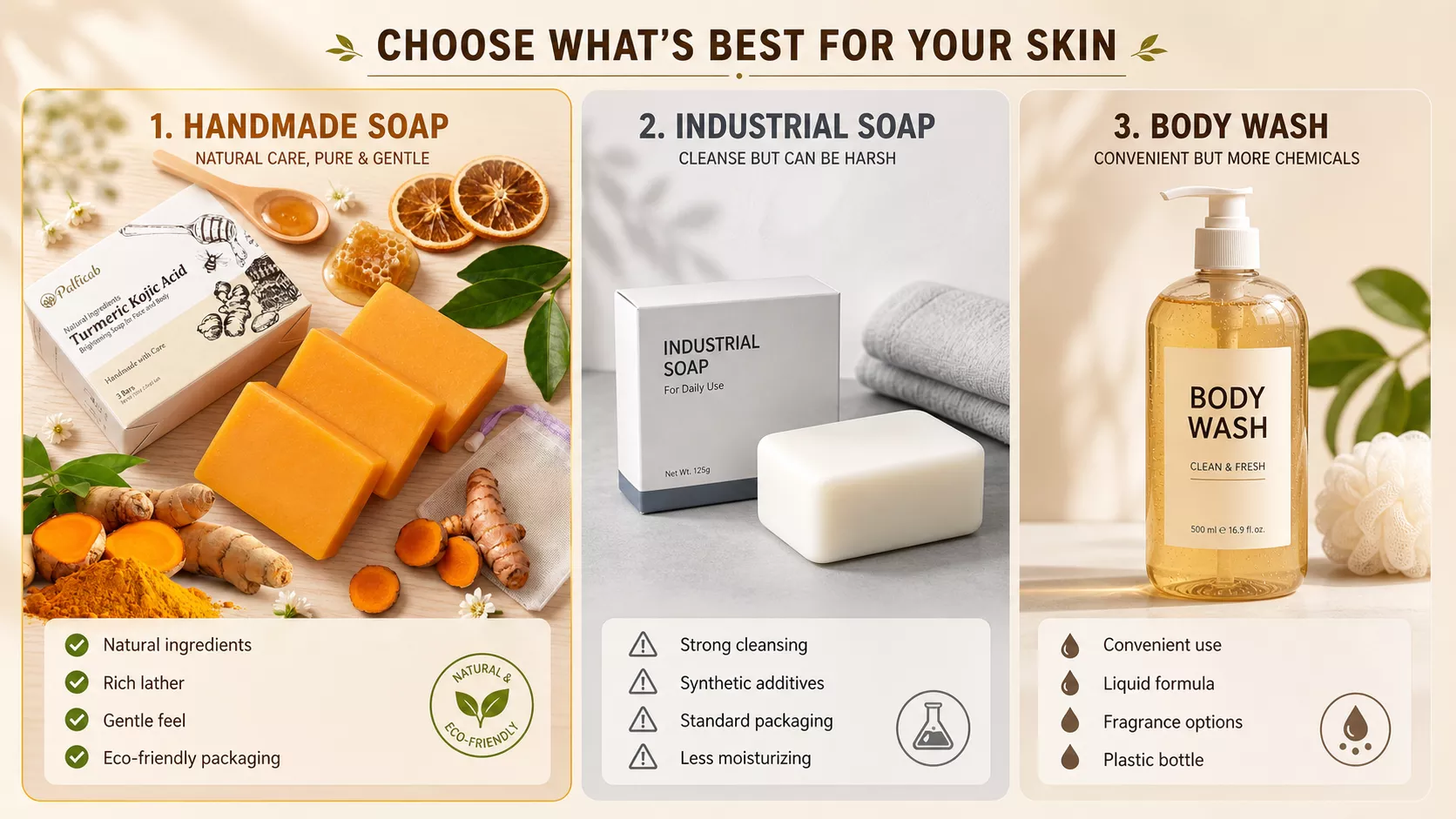
Pick up a bar labeled “soap” at a supermarket and a bar labeled “handmade soap” at a farmers market, and there’s a decent chance neither one is chemically what you’d call soap in the strict sense — and the two aren’t necessarily made the same way at all. The word “soap” gets used loosely enough on packaging that the label alone doesn’t tell you much. What actually matters is the process behind the bar, and that process changes three things you can feel on your skin: how much moisture it strips, what pH it lands at, and what’s left in the bar once it’s done curing.
Here’s what’s actually going on chemically, and how to tell which one you’re holding.
What Makes Soap “Soap”
True soap is the product of a reaction called saponification: fats or oils (like olive, coconut, or palm oil) combined with an alkali — traditionally sodium hydroxide, or lye — in the presence of water. The reaction breaks the fat molecules apart and recombines them into soap salts, releasing glycerin as a natural byproduct.
That’s it. That’s soap. No detergent, no surfactant chemistry — just a fat molecule chemically converted into something that can bind oil and water together, which is what lets it lift dirt and grease off skin and rinse it away.
Handmade cold-process soap is made this way: oils, lye, and water combined at low temperature, poured into molds, and left to cure for four to six weeks. During curing, the saponification reaction finishes completing, excess water evaporates, and the bar’s pH gradually drops as it stabilizes.
What Most Commercial “Soap” Actually Is
Here’s the part that surprises people: most bars sold as “soap” in drugstores and supermarkets aren’t true soap at all. They’re syndet bars — short for synthetic detergent — built from petroleum- or plant-derived surfactants rather than saponified oils. They’re manufactured to be pH-balanced (often in the 5.5–7 range), which is one reason dermatologists frequently recommend them for eczema-prone or very sensitive skin: they sit closer to the skin’s natural surface pH than true soap does.
Where commercial products diverge further from handmade soap is in processing. Large-scale soap manufacturing typically uses a hot or continuous process for speed and consistency at volume, and it’s common industry practice to extract the glycerin produced during saponification and sell it separately — glycerin is a valuable ingredient in its own right for lotions, syrups, and pharmaceutical products. What’s left behind is a bar with a shorter ingredient story: it cleans, but the moisturizing byproduct that would naturally balance that cleansing action has been pulled out. Manufacturers often add back synthetic emollients, silicones, or humectants to compensate — which is why “moisturizing” claims on a commercial bar don’t necessarily mean it retained its own glycerin.
The pH Question, Honestly
This is where a lot of soap marketing overstates things, so it’s worth being precise.
Human skin has a naturally acidic surface, often called the acid mantle, generally sitting somewhere around pH 4.5 to 5.5. This acidity supports the skin’s barrier function and the balance of resident bacteria that help keep skin healthy.
True soap — handmade or industrial — is inherently alkaline because saponification is an alkali-driven reaction. A well-cured cold-process bar typically settles somewhere in the pH 8–10 range; it can be nudged lower with superfatting (leaving a small percentage of oils unsaponified) or additions like citric acid, but it can’t be brought all the way down to skin’s natural pH and still be true soap in the traditional sense. Syndet bars and most liquid body washes, by contrast, are formulated with surfactants specifically because that lets manufacturers dial the pH down closer to skin-neutral.
So the honest comparison isn’t “handmade soap is gentler because of pH” — on pH alone, well-formulated commercial syndet products often have the edge. Where handmade soap tends to compensate is in what accompanies that alkalinity: retained glycerin acts as a humectant that helps offset the drying effect of a higher pH, and a well-superfatted bar leaves a small residual layer of unsaponified oil on the skin after rinsing, which further cushions the effect. It’s a trade-off, not a clean win either direction.
Body Wash: A Different Category Entirely
Liquid body wash isn’t really a direct comparison point to bar soap at all — it’s built on a different base chemistry from the start, using surfactants like sodium laureth sulfate or milder cocamidopropyl betaine, combined with thickeners, preservatives, and fragrance. Because it’s liquid, it also needs preservatives that a low-moisture soap bar doesn’t require to the same degree.
Body wash formulations vary enormously in gentleness — some are quite mild, some are aggressively foaming and stripping — so “body wash” as a category can’t be generalized as better or worse than either type of soap. It comes down entirely to the specific surfactant blend and what’s been added to offset it.
So Which One Should You Actually Use?
There isn’t a single correct answer — it depends on what your skin needs.
Handmade cold-process soap tends to suit:
- Normal to dry skin that benefits from retained glycerin and a light oil residue
- People who prefer a short, recognizable ingredient list
- Anyone specifically looking for a bar built around a particular active ingredient — botanical oils, clays, or targeted extracts — since small-batch production allows more formulation control than mass manufacturing
A pH-balanced syndet bar or gentle body wash tends to suit:
- Eczema, rosacea, or otherwise reactive skin, where minimizing pH disruption matters most
- Very oily or acne-prone skin, where some commercial surfactants are specifically formulated to manage excess oil
- Anyone who finds bar soap of any kind to leave a filmy residue
What to Actually Check on the Label
Ingredient lists tell you more than marketing language does. A few things worth looking for:
- “Sodium [oil name]ate” ingredients (e.g., sodium olivate, sodium cocoate) indicate true saponified soap. “Sodium lauryl sulfate,” “sodium laureth sulfate,” or “cocamidopropyl betaine” near the top of the list indicate a syndet or detergent-based product.
- Glycerin listed as an added ingredient on a bar soap suggests it was extracted during processing and added back — not necessarily a bad thing, just worth knowing.
- A short cure time or “ready to ship” claims on a cold-process soap can mean the bar hasn’t fully cured, which can leave it higher in pH and softer than it should be.
- Superfatting or “extra oils” language on handmade soap indicates the maker intentionally left a percentage of oils unsaponified for added moisture — generally a good sign for drier skin types.
The Bottom Line
Handmade and commercial soap solve the same basic problem — combining oil and water so dirt rinses away — but they get there through genuinely different chemistry, and each comes with real trade-offs rather than one being objectively superior. True soap retains glycerin and residual oils but runs more alkaline; commercial syndet bars and body washes can be tuned closer to skin’s natural pH but often trade away that naturally occurring moisture. The right choice comes down to your skin type and what you’re trying to solve — not which one has the more artisanal-sounding label.
This article is for general educational purposes and isn’t medical advice. If you have a diagnosed skin condition, it’s worth checking with a dermatologist before switching cleansing products.
